
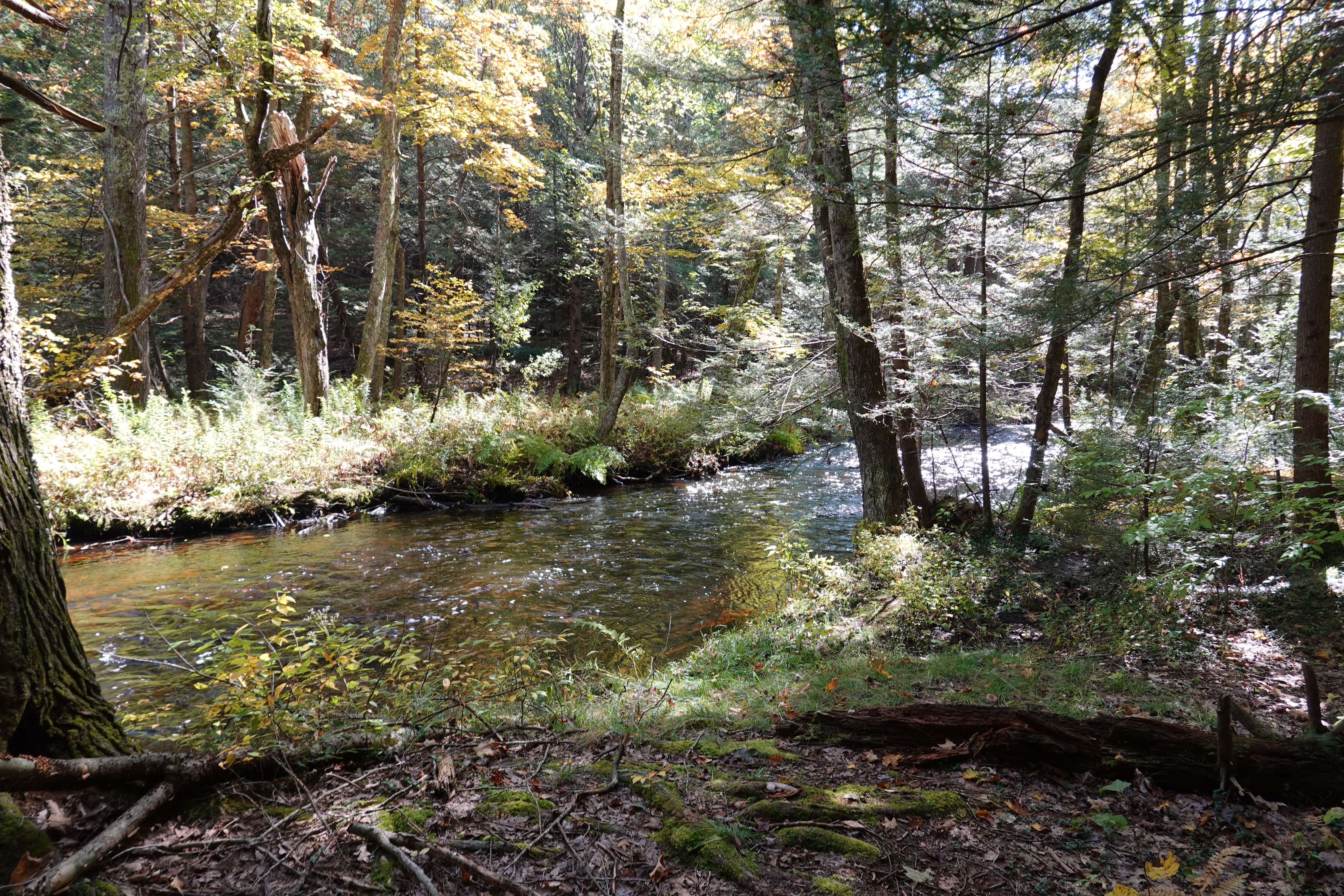
by Timothy Loftus.

Two quart-size containers of water, one for drinking on the move, the other for tea when I take a break.
Tea (of course!).
Backpacking stove, fuel, titanium pot, tea mug.
Apple.
Flask with a dram of Irish whiskey.
Notebook and mechanical pencils (black plastic body with a yellow pocket clip).
Wide-brim hat to keep the sun off my face. (I know of too many people who have had patches of skin cancer removed. I don’t want to look like an old boxer whose nose looks like a kindergartener molded a new one out of clay in art class. Or have my ears look like the dog used them as chew-toys).
Hiking boots, double knotted.
I’m ready, I think. Check again. Then one more time.
*
This fine early October morning in 2023, I park my car in the gravel lot opposite Buck Hill Pond in northern Spencer, Massachusetts, hoist my knapsack onto my back, then leave my boot prints on the trail along the south shoreline before it turns northwards. In another quarter mile, I will come to a trail junction. Then I will decide which way to go, as I will at every trail junction during today’s coddiwomple.
Even after meticulously packing my knapsack this morning, I had no idea I’d eventually end up here, at the Buck Hill Conservation area twenty miles from my home. And at this point along the edge of the pond, I still have no idea where I’ll meander to on foot. Ahhh, the beautiful marriage between precision and randomness! Preparedness and freedom at the same time.
This is a far cry from the decades of planning group hikes in the Scouting program, leading college students on winter hikes in New Hampshire’s White Mountains, and as an upcountry hike leader for the Appalachian Mountain Club. Those hikes were fun for all, including me, but as a leader, I was generally disengaged from the experience, constantly checking on each hiker’s well-being, following pre-planned routes on trail maps, looking for trail markers, and glancing at my watch for turn-back times.
“Coddiwomple,” buried within the generally ignored slang words of the English language lexicon, is a fun word to say. It’s even more fun in the active sense: to travel in a purposeful manner toward a vague destination.
My Irish ancestors had a similar Gaelic word: seachrán (shuk-rawn). Except this word carries the overtone of a fool’s errand, even a touch of madness.
If accused of coddiwomple or seachrán, I’ll raise my hand to both.
I had recently found the word coddiwomple as I, now know, coddiwompled around the internet one day out of boredom. And seachrán? Not a word I heard in my five years of studying the Irish language until a decade later when I read where someone used it to imply his experience of foolish wandering. I looked it up in my Irish dictionary, and sure enough, there it was. Except in Irish, it’s not slang. They understand.
Wished my mother knew of these words when I was a teenager. It would have explained a lot to her, especially when I’d walk out the back door to the fields and forests behind our house or hop on my bicycle for another half-day ride.
“Where are you going? Looks like you’re packed for a week,” my mother often asked me while eyeing my knapsack.
“I don’t know yet.”
“When you coming back?” she’d press further.
“I don’t know yet.”
“Home for supper, then?
“Maybe.”
Now that I think of it, my father coddiwompled a lot, too. For almost every question my mother posed to him, “Where are you going?” “What are you looking at through your telescope?” “Why are you watching that tv show and not your regular one?” his fallback response was always, “I don’t know.”
And I had always thought he just didn’t want to answer her. In hindsight, I understand now he was just coddiwompling. He’d start something, then follow it to wherever it took him.
Aye, he had the full Irish seachrán gene.
*
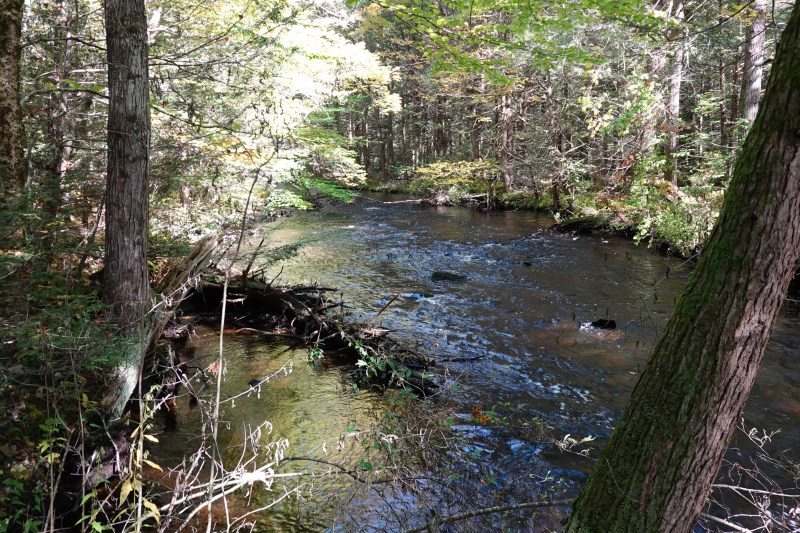
I follow the trail to the other side of the pond where it passes through a hemlock stand, and later through hardwoods before terminating at the junction of the Mid-State Trail (MST). The MST is a ninety-six-mile-long trail from the New Hampshire border, through Massachusetts, and ends at the Rhode Island border. I look both ways and ponder. Should I turn right, or should I turn left? I chose right to head south. Why not? I’ll follow that trail for a spell.
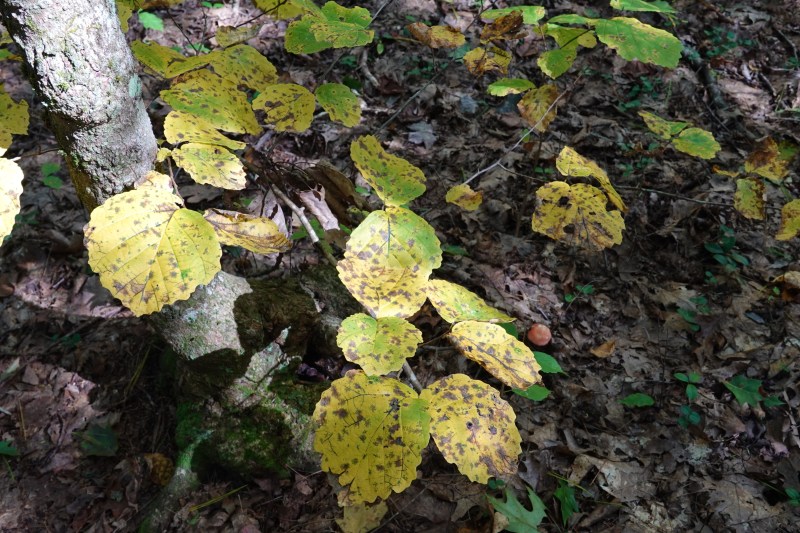
A small copse of Witch Hazel shrubs looks as if they are tumbling onto the path. It was a good year with lots of rain and sunshine, and the shrubs grew most where they had the room to stretch out their branches. I had been standing at this very spot a few years ago when three Chestnut-sided Warblers checked me out, all males sporting yellow crowns, black Zorro-type eye masks, and a warm-chestnut colored brush stroke on each flank. Their soft calls greeted me with the often transcribed pleased pleased pleased to MEET-cha.
A few more yards southward on the MST, I find the remnants of a trail I helped build in 1977. I was fifteen years old that summer, and working for the Youth Conservation Corps. I follow this trail over the moss-covered log bridges I had hewn from log pines almost a lifetime ago, through a hemlock swamp, to where the trail fizzled out from years of neglect and successive vegetative growth near Turkey Hill Brook. In my late teens, I used to fish for trout in that river, imagining I was deep in the wilderness, away from the sound of human noises. And I was, really. Even found a large deer antler there in the winter once, a shed dropped after the mating season. This antler followed me though college, a marriage, kids… Now my son, over thirty years old, has it decorating his home.
I wander back out to the MST and continue southward. I meander around the half dozen fallen trees that block the path, take pictures of trail-side Partridgeberry, and observe the glistening silver-colored slime trails left behind by a slug on its own coddiwomple.
Three miles later, I sit on the edge of a fire pit at the Moose Hill three-sided shelter. This is a nice stopping place, I think – surrounded by trees, a tiny pond in front.
My tea water heats slowly over the soft hum of the stove’s low blue flame. No sense rushing. I am under no timeframe.
I pour myself a dram of the Irish whiskey; nothing crazy, just my connection to my ancestors, from a flask that has never tasted anything but aged Irish whiskey.

This flask cost me about five dollars a decade and a half ago. For another fifty dollars, I had it engraved with the last three lines from a W. B. Yeats poem, “The Song of Wandering Aengus,” a poem steeped in Celtic mythology, about Yeats’ own unending wandering search for artistic creation – fed by the heavenly and earthly ideals represented by gold and silver apples. His seachrán. His coddiwomple.
And pluck till time and times are done
The silver apples of the moon,
The golden apples of the sun.
I eat my only snack, an apple. Had I known the connection beforehand, I would have woven it into a joke. But, alas, I must admit that it is the great Irish poet Yeats himself with the tease.
The tea is ready. I open my notebook and write my thoughts, free-flowing, a mental coddiwomple of sorts, my seachrán, exploring bits of ideas, weaving in and out of words, over or under others.
I don’t know where I am going today, either on foot or in mind. And that is fine with me. I will know my destination when I arrive.

BIO: Tim Loftus is a retired environmental chemist with a love of the written word. When he is not at his writing desk (by 6:30 every morning) he is most likely outside, leaving his boot tracks along some woodland or meadow trail. Tim’s recent essays and articles have been published in Yankee Magazine, Boston Magazine, Prescott Living, and Northern Woodlands’ The Outside Story. He resides in Central Massachusetts with his chive plant.
SUBMISSIONS OPEN! We’re taking ideas through the website contact form, just give a sense of what you want to share with our international audience of over 179,000 so far! We focus on personal experiences, approx 1500 words, include a short synopsis and bio please.
Go to the Contact form on here,
Thanks, Brianna and Sarah
If you are looking for a developmental editor, check out how I can help your writing become what you aim for, building upon your skills and showing you patterns that might or might not like to continue using…Having a professional reader/editor work with you can make all the difference.
Let me know if you have any questions, cheers. Sarah
Donations really help. Wanderlust Journal is a free online resource for publishing and reading travel essays and photo-stories. Same for Substack. Pretty much for everything I do…! It’s lucky I live in a little caravan (Travel trailer to you) and enjoy nature more than shopping. Anyway, even if you can only give a little, it helps me do what I’m committed to doing, ever since a teenager, and that is documenting other lifestyles, cultures, experiences. Think of these projects next time you are able to give a little, thank you.
If you’d like to hear more hiking stories, listen in to the podcast. We had an episode that had a range of excerpts today with a kayak from California to Hawaii, a solo biker in Iran, a couple of fellas in boxers, and more! Yes, a fun selection. We only do podcasts when we have something to share so don’t worry if you subscribe that you’ll be overwhelmed. You won’t!

 Wanderlust
I’ve read through your blog and just wanted to say—this really hit home. You’ve got a strong, honest voice as a travel journaler. As a former Everest region blogger (and now full-stack dev), I’ve felt that same odd mix of being fully prepared but open to wherever the trail leads. Your take on coddiwomple and seachrán is beautiful—felt like you were putting words to feelings I’ve had for years.
Only thing I’d suggest: would love to see the mechanical pencils make a comeback later in the piece—maybe during the journaling moment by the fire. Also, a tiny bit more clarity at that first trail junction could help ground readers unfamiliar with the area.
Really enjoyed this. Quietly powerful stuff.
LikeLike