
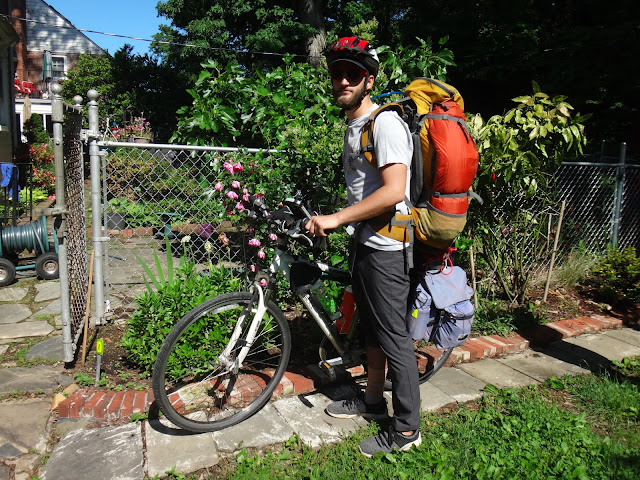
by Rudy Schreiber
Preface
T minus ten days to kick stand up. In five days, I graduate from college into the unknown world of Covid-19. For the first time in a long time, I will be free of the bonds of education.
Ever since elementary school, I have been wanting to ride the entirety of the C&O trail. I’ve made a few weekend camping trips along the trail by myself or with friends from Boy Scouts but never before have I had the time to bike the whole trail. As I waste away, quarantining in my parents’ house, my mind is atrophying. I need a challenge. I need a purpose. Something other than half-assing elective classes online and binging TV shows until 3am. The plan, before the virus, was for my family to take a long car trip to Idaho, between graduation and the time my summer job starts at an outdoor camp. With the pandemic that changes everything. My deliverance from boredom will come in the form of this herculean bicycle venture.
The plan: to bike the 184.5 mile towpath of the C&O canal from Georgetown in Washington D.C to Cumberland, Maryland. From there, I will take the 150-mile-long Great Allegheny Passage to Pittsburgh. Once I’ve reached there, it’ll be the whole thing over again in reverse: 669 miles, plus the 15 miles from my house to the trailhead.
The preparation: After talking to a mentor of mine who hiked the Appalachian Trail, I’ve been fascinated with the idea of hammock camping. It’s lightweight and smaller than a tent, plus you don’t have to sleep on the hard ground. Camping hammocks that include bug netting and a rainfly cost anywhere from $300 to $1,200, but I’m a broke 22-year-old, so I use my Eno hammock, a construction tarp for a rainfly, and a separate bug net for $50 from REI. I sleep on my stomach naturally, so before the journey I spent several nights sleeping in my hammock in my backyard in an attempt to train myself to fall asleep in a hammock. I’ve logged over 100 days camping with the Boy Scouts and may have easily doubled that number by my summer camping job and taking my own trips. Still, much of that has either been car-camping or only weekend trips. I don’t have much experience with long-term trips or carrying non-perishable food.

Camping stores are closed for Covid-19, and buying freeze dried food online is impossible, because it’s sold out everywhere as people plan for the worst. Normally the C&O canal trail is very forgiving, because towns line the path. On my last excursion, I met two older men who biked with nothing on them but their lunches for the whole trip, because they could stay at motels and eat at restaurants along the way. I don’t have that luxury with this trip, as the point is to avoid people and not get sick. So, I stuff my panniers with what non-perishable food I could find in Aldi: Ramen noodles, PopTarts, baby food, Vienna sausages, etc. If I supplement the rest of my meals with fish I can catch in the Potomac, I reason that I can stop for food just once or twice on the estimated two-week venture.
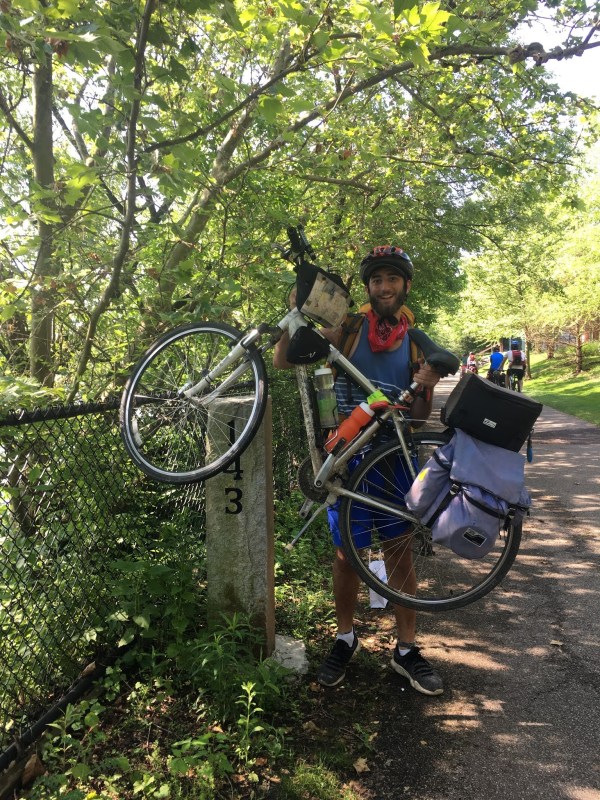
Day 1 (5/23/20): My doorstep – C&O mile 43
I wake up at eight and am ready by nine, after having one last meal of civilization (fried egg and cheese sandwich). I weigh myself and all my gear one last time: I’m 170 lbs.; gear is 30; food is 27. My departure is delayed as my parents insist on taking pictures and saying long farewells, but I manage to get on the road at 10. Frustration builds: people are blocking the sidewalk, in my way, and ignoring the sounds of me ringing my bell. When I finally reach the trailhead to begin on the C&O, it’s an unceremonious crossing.
I tried to conserve my phone’s battery power for as long as possible, but I grow bored; having made it to the trail, I reward myself with the entertainment of the Jack London audiobook I’ve almost finished, The Mutiny on the Elsinore.
At mile marker 16, I stop for a lunch of summer sausage, cheese, and crackers. Sitting on a rock and chewing, I glance at the river and see a brownish-black water snake (I think a cottonmouth water moccasin) swim right by me. Following the meal, the trail turns from solid gravel to mud, thanks to yesterday’s storms. At first, I’m relieved to be on soft earth, since the weight of my cargo jostled on my back going over the hard pebbles, but my gratitude falls through when, as the dirt morphs into wet slush, my wheels slide under me and I almost wipe out twice. The panniers on my bike are caked in mud splatter.
With my pace slowed to that of a snail, I arrive at a part of the trail where a small crowd has gathered in my path. Drawing closer, I discover a large copperhead snake sunning itself across the trail, blocking all forward motion. Because of its venomous nature, nobody is willing to shepherd it out of the way. A few people try to throw rocks near it, hoping to scare it away from a distance, but it doesn’t budge. After some time, an old man braver than the rest of us picks it up with the end of his stick and places it elsewhere.
I push on through the sludge, but now the weight of my baggage sinks my tires lower and lower. I stand on the pedals the entire time, trying to force the bike forward. Right as the mudslide ends, I narrowly skirt around the third snake of the day (a black rat snake, also basking in the sun and extended over the width of the path). To congratulate myself for getting through the mire, I take a snack break at mile marker 26 and finish my audiobook.
I call it a day some seventeen miles later — the plan was to hit over fifty miles a day, but there’s wiggle room to stop a little shy of that goal, since the markers don’t incorporate the extra distance to the trailhead from my house.
Someone is with me at the campsite, but since there is only one picnic table, which is near her, after setting up my hammock, I have to invite myself over to prepare supper. I boil two frozen hot dogs, slice them up, and lay it with a block of cheese on a tortilla. I’d meant to first cook a bit of summer sausage, and then use the grease to fry my quesadilla, but I’m a fool and forgot to do that, so the quesadilla burns and sticks to the pan. I rescue what I can and eat it. Not bad.
Chatting with my fellow camper, I learn she’s on a weekend trek from D.C. and will be heading back in the morning. I can’t read whether she enjoys my company or would prefer to have to table and camp to herself. I probe the situation delicately, making small talk about the mud we went through and our mutual want to do the Appalachian trail one day. She plans to bike the entirety of the trail, like I am, between the end of her current job and the start of her new one. Still I have no read of her, until she invites me to join her at a fire when it gets dark. It occurs to me that I might have more company than expecting, since it’s Memorial Day weekend, but come Tuesday the trail will get lonely at night.
She says she took a dip in the river and found it quite refreshing, and I’ve got time to kill before dark, so I strip to my boxers and jump in — being extra vigilant, because the last time I was in the Potomac, on this trail, I got a black leech on my ankle. Afterwards I towel off with my shirt, just so I can drench it in the river and rinse my sweat off it.
I tell my associate I’d take her up on the offer to share a fire, but she says she didn’t collect any firewood. Good thing I did. I bring mine over and we set it aflame. Around the fire we discuss the pandemic, and how now is a good time to isolate in the woods. She encourages me in my journey to Pittsburgh and back, and gives me her number, so I can let her know what the conditions are like, when she does the trip in a few weeks. With that, she wishes me happy trails and goes to bed.
Day 2 (5/24): C&O mile 43-99
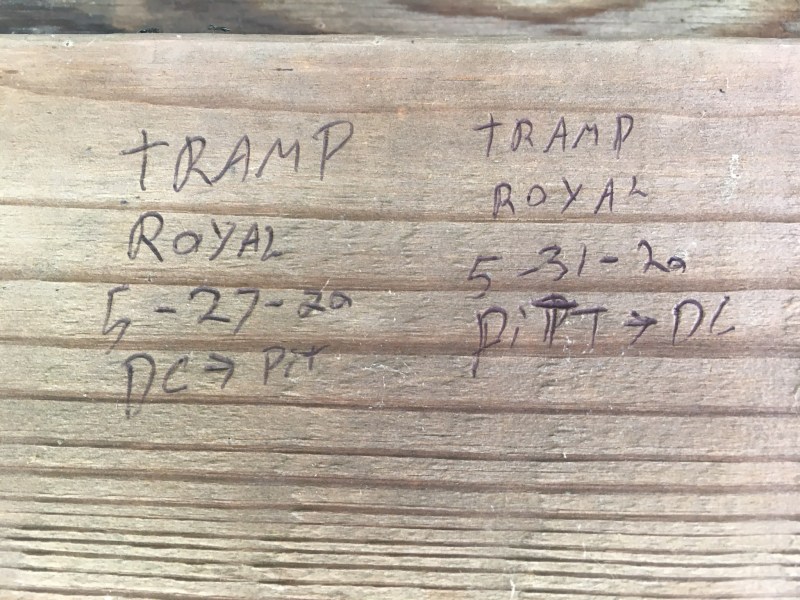
After a fitful sleep trying to adjust to sleeping prone on my back, I wake up at sometime between 8:00 and 9:00 (only to later learn that my watch is running slow). To make sure I don’t linger about breaking camp, my strategy is to not eat breakfast before I’ve put in miles from where I slept. I set out after clicking on a new Jack London audiobook,The Road — a recollection of true stories from London’s time as a “tramp royal”, criss-crossing the country, sneaking on train’s boxcars.
It was so humid last night that the shirt I washed in the river didn’t dry when I draped it on my hammock strings overnight. And it turns out, the clothes in my bag are even wetter, because the water bladder in my backpack sprung a leak. I consider airing them out, on the outside of the backpack, but there’s too much cloud cover for that to do any good. In fact, it’s so cold that I put on the separate sleeves I’d packed: I probably look like an idiot, wearing a tank top with separate sleeves. Oh well. It’s a towpath, not a runway. Continuing on my way, I pass Harper’s Ferry, officially exceeding the furthest distance I had biked so far on the path, from previous weekend outings. Now into the unknown I plunge.
I stop for breakfast five miles down the trail. I fix myself more summer sausages and gobble the last of the block of cheese, overlooking the rapids as I do so. I’d brought along some recently-purchased throwing knives, and while I’m chewing, I manage to stick all three into a tree trunk on the first toss. As the weather begins warming up, I trade my tank top and extra sleeves for my damp T-shirt.
Already saddle-sore on day two, I give my butt a break and stand on the pedals for a while. Thinking about how raw my ass will be at the end of this trip.
I stop to refill my water bottles with my hand-pump filter by the river. Technically, the trail is closed to campers since all the rangers are working remotely, but they can’t really close the campsites, so they just removed the handles from the water pumps and closed the port-o-potties. Fine with me, because I brought my own water pump and my own trowel and TP. They can’t stop me, just inconvenience me.
Diverging from the path, I approach the mouth of a cave. Checking for bears, I shouted into the cave, but nothing stirred or roared back at me, just my own echo. There’s a stream of water running along the bottom, and I’m in beat-up sneakers, so I’d rather not ford through it. I stuff my lunch into my cargo pockets and use my outstretched arms and legs to trace the curving walls as I go in deeper, hoping not to slip on the slick surface, and rejoicing when a good handhold appears. I creep along as far as I can, while keeping daylight in sight. (I’d actually brought my headlight with me, but I’m not prepared to go spelunking right now. Too many miles to put in.) Having found a suitable resting place at last, I bite into a chalky chocolate protein bar, watching my new friend, a skinny spotted yellow salamander, thankful he is not a bear.
Keeping on the path, nothing of note happens except the end of my fourth Jack London audiobook (The Road), just as I reach the top of Dam 4. I catch my breath while gazing at a cascade of water descending a 10-foot drop. An older couple notices me with my gear and they strike up a conversation: They’re doing the trail from the opposite direction, but have had the chance to stay in hotels along the way, so their equipment is just ““tons and tons” of water and lunch. They tell me about section-hopping the AT, and I respond that if my summer job doesn’t pan out, that will probably be my plan.
“The water is the best part of the AT,” the woman exclaims.
“Better than champagne,” her companion agrees. I fail to get either of their names, but the old man and woman do give me their trail names: Pain and Suffering, respectively. (I hope I’m able to do this trail when I have gray hair, even if I have to wimp out and stay at hotels the whole way.) They’re hungry for company, having completed most of the trail with just each other, but I have miles to go and so I make a polite exit, giving them a “Happy Trails!” as I leave.
To Be Continued…(and is but is too long for on here!)
BIO: Rudy Schreiber is a Director, Playwright, and Sailor, 100-Ton Masters inland with sail. Find out more at https://rudywanders.blogspot.com/

SUBMISSIONS OPEN! We’re taking ideas through the website contact form, just give a sense of what you want to share with our international audience of over 179,000 so far! We focus on personal experiences, approx 1500 words, include a short synopsis and bio please. Thanks, Brianna and Sarah
If you are looking for a developmental editor, check out how I can help your writing become what you aim for, building upon your skills and showing you patterns that might or might not like to continue using…
Let me know if you have any questions, cheers, Sarah L
Donations really help. Wanderlust Journal is a free online resource for publishing and reading travel essays and photo-stories. Same for Substack. Pretty much for everything I do…! It’s lucky I live in a little caravan (Travel trailer to you) and enjoy nature more than shopping. Anyway, even if you can only give a little, it helps me do what I’m committed to doing, ever since a teenager, and that is documenting other lifestyles, cultures, experiences. Think of these projects next time you are able to give a little, thank you.

 Wanderlust
Best wishes and happy trails!!! From 2007-2012 I made 3 cross-country trips. Twice by bicycle and one by foot.
👉 Follow me on NewsBreak https://www.newsbreak.com/@c/1869838?s=01 for exclusive updates and more!
LikeLike